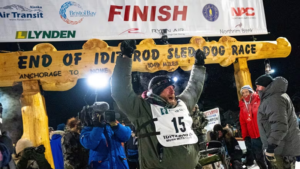


Thomas Waerner, 47, was born in the UK and moved to Norway when he was young.
He made his Iditarod debut in 2015 taking the Rookie of the Year award and finishing in a respectable 17th place in just over 9 days.
Thomas also won the Femund and Finnmark races last season.
He is married to Guro, who is a veterinarian and she also races sled dogs and they have five children and live in Torpa, Norway.
I was lucky enough to speak to Thomas on the telephone for over 40 minutes. He shared his passion for dog mushing and his excitement of completing his dream of becoming an Iditarod champion.
Faye : First of all, congratulations on becoming this year’s Iditarod champion.
Thomas : Thank you
Faye : You’re welcome. Tell us what it felt like crossing the finish line.
Thomas : It’s always really strange to cross the finish line. It’s kind of emotional because you’re coming to the end of something I’ve been dreaming of for many years. Suddenly, it’s over. So actually, you get a little empty inside, so actually crossing the finish line is a very strange feeling.
Faye : At any point during the race, did anything go wrong for you?
Thomas : Well, I think dog mushing, especially if it’s long races, actually so many things that can go wrong and are going wrong that you have to deal with. That part of the racing actually, that you have begun to deal with, with all these issues, and try to find parts of the ways to actually deal with them. So yes, of course, a lot of small things but not any big things.
Faye : When you set off on your 1000 mile journey from Anchorage, did you imagine you would cross the finish line as the winner ?
Thomas : Before the race, I knew that I had a team that were awesome. You know, they are so great animals and they have so good attitude, you know, and they are just – they love what we are doing and what we’re doing together, you know, travelling down the trail and I knew I had a team that’s possible to win with them. And of course, my dream was to win of course, but I didn’t expect it but hoping is more the word.
Faye : Yeah. Well, you did.
Thomas : Yes.
Faye : So that must have been a nice surprise, if you weren’t expecting it.
Thomas : We are driving, but it’s not like you are expecting. I don’t expect to win, but I will do everything I can to win.
Faye : Yeah, I understand that. Do what you can to win. If you don’t, you’ve still achieved a big dream haven’t you, but even better that you have. Which dogs were on your team this year, and why?
Thomas : Well, this is actually a team I started building in 2015, after my divorce, so it was not until 2019 that was the first year they were actually ready to race on a higher level. So I’ve been actually working with these dogs since they were puppies and then building them up and making them actually ready for race.

Faye : Is there that one special dog ? Do you have one dog that’s extra special to you ?
Thomas : Well, you know, all the dogs are special, and you’re working so much with them all. But you know, you need those lead dogs with that little extra drive in front. So that actually will give you your victory and you know, will keep the speed up. But of course, my two lead dogs that I’ve been using a lot are K2 and Bark, that are two amazing dogs.
Faye : Do you agree that a musher can read their dogs and vice versa?
Thomas : Yes, and I think the worst thing for the musher is actually the dogs are reading you, you know, you can’t put on a fake performance for the dogs. They will know in what kind of mood you are, if you’re sad or feeling bad, or you know, cold or you know, and they will pick up on it. And they will also pick up if you want too much.
So it’s very important for a musher to actually try not to be too happy or not to be sad, but just enjoying the moment and give the dogs confidence and then not worrying about the musher, what kind of mood he is in. So that’s really important that the dogs, you are controlling yourself. So if you’re really happy, the dogs actually start to perform too hard. If you want to start actually moving faster down the trail, but you know, you don’t want to go too fast when you are going that long distance.
The same is if you’re getting in a bad mood and you’re not able to focus in a positive way, you know, they will also probably go slower. So the dogs are reading you so much and it’s of course, really important to look for signs in the dogs especially. That’s why you have to know your dog really well, that it’s so you know how they are feeling and if something is wrong. So some might have a little rub or something you have to put ointment on, you know, and you have to always look for the small signs, and the dogs will give you signs. What they are feeling.
Faye : What kind of training goes into preparing for a long race?
Thomas : Well, I think the most important is the mental training and giving the dogs a picture of what you are expecting them to do. So they know what you’re going to do, and you don’t put the dogs in a position to something they are not ready for. I think that’s the most important. And dogs are incredible animals. And if you look at their heart rate, and then the oxygen they can actually take in, you know, they are so high you know, performance dog, so it’s just incredible what they can do.
Faye : It Is that yes, I totally agree with you there.
Do you take part in any other races? And if so, which one’s your favourite?
Thomas : Well, I think the most challenging race, and I like challenges, is the Iditarod, because you go through so much different countryside you know, you come from the inside of Alaska and can be really, really cold and storms and everything and then you hit the Yukon away and going on this wide wide actually kind of feeling of being on Lake and then coming up on the coastline. So I really like the way Iditarod set up and also that you this you and the dogs because like, also, you know, Femund race and Finnmarks race are really nice races but, you have this handler team and support team that you actually have to have with you to actually win the race. But I like the set up in Iditarod and it’s just beautiful countryside. It’s not much people. And yeah, it’s amazing.
Faye : It sounds amazing. I can’t imagine just being out there on a lake with just the dog team. It must be absolutely awesome.
Thomas : Yeah, it’s a good feeling.

Faye : Tell us a bit about your day to day life. What you usually would do on a typical day.
Thomas : Well, I have actually a lot of time to my dogs. So I have about four days a week that I can just focus on the dogs And the other three days I’m actually have to work a little to make some extra money. so It is a busy, complicated, rich life. That’s what I call my life.
Faye : Going back to the beginning for you. How old were you when you knew you wanted to do mushing? Were you born into it? Or did you decide at a young age?
Thomas : Well, I was actually 11 years old when I started with mushing and I always had this really interest in dogs. You know, since I was really small. I’ve been petting dogs. I’ve been touching dogs. I wanted to see them. So and then I started with the dog mushing, because I just wanted to do more things and then have more time with dogs.
Faye : Yeah, I totally get that. I don’t think there’s anything I don’t do without dogs in it. And how often do you train your dogs?
Thomas : I like to train them five days a week.
Faye : Where do you go? Have you got one particular route that you stick to or different routes ?
Thomas : Oh, you know, training dogs. It’s different types of training. You know, you train heavy in August and September, and then maybe you’re going to other places, use little more camping and show the dogs, you know more to camping life in October. And in November, December, you’re more showing more of what’s actually happening in the races. So you’re going a little more distance you’re having you to go, you know, eight hours sometimes and sometimes short also. So you actually building the dogs up from August to December when the races starts.
Faye : So you go a little further each time then?
Thomas : Not really I train. I don’t worry about the distance. It’s more showing the dog the picture what I want. And sometimes you have older dogs, so you show and show them less. but sometimes you have young dogs and you actually have to do more work to actually prepare them for what they are gonna do.
Faye : So do you have any other hobbies that don’t involve dogs? Or is everything you do like me, pretty much to do with dogs ?
Thomas : You know, with family, work and dogs, it’s really hard but I really have interest in old muscle cars. I actually have one old Ford Mustang with a lot of horsepower.

Faye : Can you tell us what it was like when you got the news that Coronavirus had affected the flights? Had you finished the race when you got the news?
Thomas : Actually, I got the news during the race and the first one I got it was a message from my wife Guro, who was also a big part of this, you know at the West and she told me she had to go home because she was going to meet me, so that was actually the first time and then on a couple of checkpoints farther down the trail we actually get the news that check points were shutting down and we are not able to go into the villages so it was definitely a Corona race because we got all this message and we didn’t actually know what’s gonna happen down the trail.
Faye : That must have been scary really. So it was actually a race against time then wasn’t it ?
Thomas : This is actually what you have to deal with as a dog musher. You have to be able to get all this information or negative things happen and kind of deal with it. Find a way to kind of figure it out.
Faye : Well, I can only dream about getting stranded in Alaska with my dogs, but for you this became a reality and how long were you actually there for ? Where did you stay?
Thomas : Well, I was there nine weeks after the race, so it was a long stay but you know, I’m really fortunate I have really good friends in Alaska. So I stayed with some of my best friends and we have had a really really good time but you know, I’m a guy with a lot of energy so I like to do things and when you’re kind of stuck doing nothing to do. And everything was closed down for a long time so, it’s always nice to get home but I really enjoy the staying I had in Alaska
Faye : Well you eventually found a ride home and how did that come about ? Because all the planes were still cancelled weren’t they when you finally got a plane home ?
Thomas : Yeah, you know life is strange. I got this message in my messenger that said you know, the plane is cancelled and you see him it’s not buying the plane anymore. It got too expensive. So I got in contact with the right people. They were kind of surprised. What can you do and but knew that I had the sponsor, Qrill Pets and they are a big company and so they were taking it pretty seriously. But then life is strange, so Olly who I was living with who, is a dog musher. His son is married to Kelly. And Kelly’s parents is a neighbour to Rob, who owns Air Cargo. So you had all this thing’s actually working for me? And then it actually happened. So life is strange.
Faye : It’s not what you know, it’s who you know like they say ? What would you say to anyone with the dream of taking part in the iditarod but don’t really think they can do it?
Thomas : Well, I think if you want to race the Iditarod, you really have to want to race it because it’s complicated, you know, to get there with your pack. But it is a lifetime experience. And you will be changed after you have done a race like that. And it’s something that will follow you as a positive thing rest of your life. So if you have a dream for it, you better go for it. That’s something unique.
Faye : I hear the Yukon quest is two races in 2021. Will you be competing in both of them?
Thomas : No, I will try to compete if they are making the race like it used to be. So if they are making it longer in 2022, I will race it.

Faye : You were born in the UK? When and why did you move to Norway?
Thomas : Well, actually, my parents are Norwegian and my grandfather had a company and my father was working in the company. So that’s the reason why my me and my sister were born there. So I actually have a British passport and I’m a British citizen, and a Norwegian citizen.
Faye : I’ve actually just done my DNA test to find out my dad’s side of the family and apparently I’m half Norwegian as well. So I’d like to visit now.
Thomas : The ancient people have been going back and forth from UK to Norway. So you know, were the Vikings.
Faye : I would love to visit Norway.
Thomas : Yeah, it’s very nice.
Faye : What’s it like living in Norway? Is it a lot different from the UK?
Thomas : I think the most difference for a dog musher is that we actually have snow and stable winters. And we have high mountains. And it’s a perfect place to do dog mushing. and it’s big areas. And you’re allowed to actually travel through those land. You know, we have a law in Norway that actually are allowed to go on private land. it works in that area. So it’s a really good place to do outside sports or being out in nature with the dogs.
Faye : Yeah, that does sound amazing. It’s a struggle here with just having the dry land mushing and to find somewhere like you say to actually go
Thomas : Yeah, I heard.
Faye : Do you have a large kennel ? How many dogs do you have at present ?
Thomas : Well, actually, I like to breed puppies every second year. So one year I have puppies and adult dogs. And the next year I have my dog team. And I have the puppies. So normally, I have around 40 dogs in training. And then I have puppies every second year. I normally have 10 puppies. So the kennel it’s actually 45 to 50 dogs that’s around what i have
Faye : That sounds like heaven. My husband thinks our 15 is far too many.
Thomas : Yeah, there’s a lot of work. It’s a lot of work to take care and you know,
Faye : Yeah, but when you enjoy it, do you still see it as work?
Thomas : Well, I think you know, a lot of work, but you know, you have to enjoy being outside with the dogs, even if it’s a lot of work and a lot of maintenance of other things. But I don’t think if you don’t have that burning feeling that you want to go out. training with dogs, you know, you should not probably do it so. So yes, I have always a burning feeling that I want to get out with my dogs and I’m looking forward every winter to get on the sled and actually going on long trips.
Faye : I totally get you there. Although my sled has been shut in the garage for four years because we haven’t had any snow.
Thomas : Thats a problem

Faye : So how do you prepare mentally for the iditarod?
Thomas : Well, I think it’s really important to know your weaknesses and then try to work on them to make so they don’t kind of take over during the race because Iditarod or Finnmark race. It’s so long races that you will definitely get kind of beaten up mentally and physically. So it’s very important to be aware of what you are strong with and what you’re weak with and try to work hard. Every year I think the only way to be able to do Iditarod is that you have to race a lot and train a lot and just learn yourself to deal with things.
Faye : What was it that made you fall in love with sled dogs?
Thomas : I think, you know, being actually outside with the dogs and and actually being all of my living together, I think actually doing sled dogs is the perfect way to spend time with dogs. And it’s a perfect way to go into the nature and have the combination between dogs nature and spending time outside. So I think that’s one of the reasons and you have this energy in the dogs that is just incredible. And it’s just incredible. see them coming up as puppies and then actually being the performance dogs when they are three years old. And you know, you get proud of what you have to have.
Faye : They are pretty amazing aren’t they . Does your wife share the same passion for dogs as you do?
Thomas : Yes, she’s not as competitive as I am. But she is really into the dogs. And I think she is also one, you know, providing really good care and looking for small things, looking at teeth, looking at how they are and so we have a pretty good team on actually that. And she also races, she also going to do Femund race this winter.
Faye : So she enjoys that as much as you do.
Thomas : Yes, in a different way. I don’t think she needs to win. I like to win.
Faye : Its the taking part that counts. And if I came to stay with you for a week, what could you teach me about mushing considering I’ve never been on a sled and only ever done dry land mushing.
Thomas : While it’s different on a sled than on dry land, but I think it’s the same kind of way of racing and then doing things so it’s not so differently. But definitely I will learn you to go up in the mountains and maybe teach you to go in a little more weather, you know, with the dogs with little wind and dealing with it. So conditions and other things that you have to deal with when you’re high up.
Faye : I’m there. What’s your next goal? Well, what would you like to achieve next with your dogs?
Thomas : Well, right now I’m working really hard to get back to Alaska to Iditarod 2021 but it’s a lot of things that are not so easy now. So my goal is to get to Alaska and race already and I will also do the Femund race so my goal is to have a good Femund race and and I go to Alaska that’s the goal for the winter.
Faye : Sounds good. Good luck with that. What’s the most dangerous route you’ve ever experienced whilst out on your sled?
Thomas : I think the most dangerous thing is actually water. If you go through water or something, you know, opens up when you’re out with dogs because that’s really hard to control. And it’s dangerous for you and the dog. So I think that’s the most dangerous you have actually to deal with.
Faye : Have you ever been stuck in water with the dogs?
Thomas : Yes, you get wet and really cold.
Faye : Quickly, I bet very cold quickly. If you could start 2020 all over again. Would you change anything?
Thomas : No

Faye : Berserk kennels, how did you come up with your name?
Thomas : Well, it was actually somebody that said that this will fit your name anyway. My ex wife, we’re actually racing in Alaska. So you know, it was a good thing to use the Viking name to kind of promote our kennel and get sponsors so actually, the name gets stuck, then I just use it since this was in early 2000 actually and was racing in sprint sports.
Faye : Since winning the iditarod, what kind of things have you done ? Have you done a lot of interviews?
Thomas : Well, not really, because it’s, you know, it’s covid. And everything is shut down. But I’m in some seminars and webinars and having some speeches, but there’s not been much actually,
Faye : What did winning the race mean to you?
Thomas : I mean, actually, that a lifetime dream actually went through because I’ve been dreaming and reading about Iditarod since 1984. And it’s been kind of following me the whole way. And it’s a race that I always wanted to do and you know, of course, you dream about winning, so yeah, for me, winning, that was kind of something that has been with me for so many years.
Faye : Yeah, it must have been really emotional to have achieved something that you’ve wanted to take part in for such a long time.
Thomas : Yeah, I still think it’s kind of strange. Every time I go past the trophy, I just have to look at it, that still I having problems to think I won the race
Faye : Still pretty surreal. Do you ever get emotional during sled dog movies, that’s if you watch them, of course. ?
Thomas : Yes. Actually I do I looked at the Togo movie and I think that, you know, mushers, they can kind of look into the movie and they see things that are moving yourself. And I think if you want to be a good dog musher, you have to be kind of emotional and have empathy, a lot of empathy actually for your dogs to actually provide the best care, though. So I think this is one of the important things actually, if you want to have a good fast dog team is actually to have feelings really feel for how the dogs are doing and and having goals. So that’s why we get so much pleasure out there. Because you’re having so much good moments with the dogs, and they are giving you so much, you know, sometimes, you know, you’re standing on the sled there and you’re just proud actually of your dog team.
Faye : Yeah, definitely. Will you be taking part in the 2021 Iditarod ? If it even goes ahead at all ?
Thomas : That’s my hope. But it doesn’t look good. You know, it’s so many people that are passionate for Iditarod, and it’s so many skilled people that are working for the race, and also the state of Alaska wants the race to be there. So I think it will definitely be a race, it can be a different race this season, that maybe we’re not going to the villages, maybe we’re not going to Nome, but it will definitely be a race.

Faye : So if you do end up taking part, will you be running with the same dog team?
Thomas : Yes, I think I will have probably 12 of the same 14 dogs that I had. So, yes.
Faye : Brilliant. So then you’re in for another good chance of winning.
Thomas : But you never know, in dog mushing. In dog mushing, you know, it’s not like you can say I want to win. I won last year and you know, one year can be good, the next year can not be, things can happen. You can also have, you know, diarrhoea or something happened to the dog. So you’re, you have to kind of slow down to take care of them and you know, all good dog mushers, they are really good and taking care of the dogs and then they’ll want to push the dogs, you know, to actually achieve a goal, you know, they will win if they can see the dogs are ready for it.
Faye : Yeah, I totally understand that. So if you had to be paired up with another musher to take part in the iditarod, who would it be and why?
Thomas : Well, if I have to pair up and actually we did – me and Joar Leifseth Ulsom, who is also the iditarod champion 2018, we actually worked together, that was to helping each other with tactics and then I was travelling actually together for for a long, long time. So it’s important to have good friends and then as you know, people you trust a lot.
Faye : So when you’ve got a big race coming up like the iditarod, do you start eating healthy or do you eat healthy anyway ? What kind of things do you eat ?
Thomas : Well, I have to work a little better to eat better myself. So I’m really good with the dogs to get them to eat. But I have to actually, I have to start making a better plan for myself to sleep and to eat actually. But it’s important for me to have food that actually you want. Because one thing was happening in the race is that you lose interest in food. It’s very strange, but it’s really hard to eat yourself. And, that will affect you hard. So it was tough this year for me, because I wasn’t good enough with myself.
Faye : Would you say winning the iditarod is your biggest achievement so far?
Thomas : Yes, definitely.
Faye : Who is an inspiration to you, if anybody ? Is there another musher that you’ve looked up to when maybe that’s why you wanted to start doing mushing ?
Thomas : Well, you know, I’ve been a handler for 2 years actually, I was a handler for Roger Leegaard . And that was a really good sprint musher and actually he’s going to be one of my mentors for all the years. I also have been looking a lot on Robert Sorlie. I also have a team with Robert Sorlie that’s also a person that has been, you know, affecting my mushing for a long time. But I think I also have other people have been looking up to and trying to learn from it, you know, you have so many great mushers both in Norway, and Alaska and I’m trying to learn from and, you know, see the small things. So definitely, I think it’s very important. If you want to be good, try to learn from the people that are doing good and see what they are doing and, and find your way but, you know, I think that’s a key thing.
Faye : That’s some good advice. I noticed that your team wears the colour orange quite a lot. Is there a reason for this ?
Thomas : Yes, and we have our main sponsor Qrill Pets you know, the krill is orange, and that’s why we are so orange. So that’s a company colour. So everybody sees us
Faye : Even in the dark ! What keeps you going through such a long race?
Thomas : Well, I think, you know, you’re racing and you have a plan that you put up, but for me, it’s you know, it’s when you’re racing its just you the dog and trail and to try to be effective the whole way. And you’re just going checkpoint to checkpoint or your stopping. So you have this motivation to win, you know, and try to do your best. I think that’s one of the motivations,

Faye : Is there any point along the trail where you just feel like giving in?
Thomas : Well, I am really happy i am built the way that I don’t give up. So, no, not really, but it’s definitely part of the trail. You’re so tired. So you having problems to keep awake, that’s the biggest issue. We are in the races to actually fight sleep deprivation.
Faye : So it’s really hard, but you’re just determined to get to the end ?
Thomas : But you have to kind of really be tough on yourself sometimes.
Faye : Yeah, I bet you do. So what’s your most treasured possession ? Something that you own that means a lot to you ? Do you take like a good luck charm with you when you’re running out on the Iditarod trail ? Do you take a good look charm with you or anything like that?
Thomas : I always have my Sami belts and my Sami knife. So that’s one thing I always have with me. So I think that’s the one of the key things I have with me, actually, it’s that knife.
Faye : Well, it was definitely lucky this year wasn’t it. Is there any specific mushing gear you would recommend ?
Thomas : Well, I’ve been working with my sponsor, actually, Non-Stop for many years. And, and I think that’s one good thing to have. If you’re working with the company, you can also, you know, help them to make the equipment that you really want. So that’s really important, and the thing with dog food, you know, it’s really important to have the right nutrition, and be able to actually give the dogs you know, the perfect balance of everything they need. So, this is really important. If you want to have dogs actually happen to have a healthy is actually to have a good programme, how you’re going to feed them actually. So that’s actually one of the most important things in dog mushing.
Faye : Can you explain the bond between you and your dogs?
Thomas : Well, you know, you have the expression that you know, dogs are same as the owner or owners the same as the dog and I think that’s also for me, I have dogs that are really focused on me and I can just feel when I go in the dog yard you know, they all are looking at me and they all are so happy. So I think this bond we get especially when you’re doing this long races is the bond gets so special and you can just look at it after the race although they get a special extra attachment to you after you’re done this extreme thing.
Faye : You get a special bond with spending a lot of time with them as well ?
Thomas : Yeah, but you’re spending time, so much time, since from their three weeks old. So yeah, and I have all my dogs at home. I have all the puppies. I have all the old dogs everything so you know you’re spending so much time with them the whole of their life. You know, the only thing bad with dog mushing is that their are dogs are getting too old? You know, 14 years is very old dog. So I think that most hardest thing, you know, you have dogs actually, that you have to go to vet, you know, on a certain time. And I think that’s the worst thing with dog mushing actually is that you have to say goodbye to your friends actually. You know ? And that’s, that’s hard.
Faye : That’s very hard. Yes, I’ve been there. I think it’s one of the hardest things I’ve ever had to go through. Have you ever been captivated by something whilst out with the team? Like maybe the Northern Lights or a wild animal or a really bad snowstorm ?
Thomas : I think the most intense you can do in dog mushing is going into storms. And actually I like it. And I have a team that actually are performing really, really good in storms. And you get this kind of overwhelming feeling when you just feel that you are managing the nature, you are actually able to be worked with the nature and with the wind and actually go through it. And that I think that’s one of the most special feelings I get actually when I actually having going there with dog team and we are going in hard wind and hard snow. And it’s just that we are just dealing with it. And that’s incredible feeling.
Faye : Is there anything you’d like to say to your fans or followers who may be reading this interview?
Thomas : Well, I think the most thing you know, that i would say to everybody, enjoy what you’re doing and have fun with your dogs, and then try to reach your goals but have fun. I think if you’re doing one dog or whatever you do with dogs, if it’s walking with them or running with them or, or dryland you know, just have fun. And always look for the signs for dogs and try to keep happy dogs and happy yourself.
Faye : Thomas thank you so much for your time. I just want to go and run the Iditarod now I have spoken to you. It’s been absolutely lovely talking to you. Thank you so much and good luck for the future. Bye
Thomas : Bye Bye

It was an honour to speak to Thomas and I would like to say a big thank you to him for taking the time to speak to me and answer questions that I have been dying to ask him.
Thank you so much Thomas.
If you would like to know about Thomas Waerner and his Berserk Kennel you can visit his website at berserkkennel.com